This is the first in a series in which I will repost, for easy access, the Pope's addresses in this catechetical series.
Wednesday, October 27, 2010

Tuesday, October 19, 2010
How do you Adore?

"O inestimable charity! Even as You, true God and true Man, gave Yourself entirely to us, so also You left Yourself entirely for us, to be our food, so that during our earthly pilgrimage we would not faint with weariness, but would be strengthened by You, our celestial Bread. O man, what has your God left you? He has left you Himself, wholly God and wholly Man, concealed under the whiteness of bread. O fire of love! Was it not enough for You to have created us to Your image and likeness, and to have recreated us in grace through the Blood of Your Son, without giving Yourself wholly to us as our Food, O God, Divine Essence? What impelled You to do this? Your charity alone. It was not enough for You to send Your Word to us for our redemption; neither were You content to give Him us as our Food, but in the excess of Your love for Your creature, You gave to man the whole divine essence..." - St. Catherine of Siena
I was priveleged, this evening, to spend an hour with both my fiancée and Christ, in Eucharistic adoration. Her parish has a perpetual adoration chapel, and so there was no separate liturgy for the adoration... we were left alone with Christ and whatever means of prayer we might muster.
Adoration is a new practice for me, having grown up Protestant, and I found that I desired to stay very close to the theme of "adoration" in my prayers and mindset. This was difficult to do for an hour. I prayed the liturgy of adoration to myself, but found myself mostly silently singing songs of praise - every Eucharistic hymn in my book of Christian Prayer, and then every chorus of adoration I could think of - and that seemed to satisfy my conscious desire to devote this time to "adoration."
I'm incredibly new to this form of worship and spiritual devotion, so I'm asking the handful of you that might read this... how do you adore our Lord?
Recommended Listening: Christopher Tin - Baba Yetu
Oldie but a goodie - this is the Lord's Prayer in Swahili:
It's the menu music for the game Civilization IV, which explains the video.
It's the menu music for the game Civilization IV, which explains the video.
Saturday, October 2, 2010
Ramblings on the Role of Women
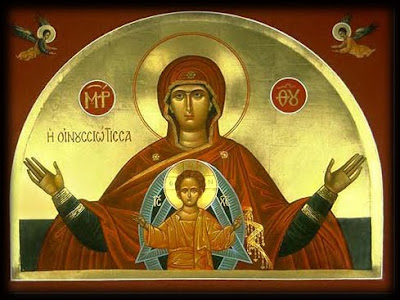
This is not to say that by "radical liberation," I mean that women should have been or should be ordained to the priesthood, but rather, that women enjoyed much greater freedom and notoriety in the first two centuries of Christianity than they likely had in the first two centuries before it, directly tied to Christ's inclusion of them in his ministry and their subsequent prominence as consecrated virgins, widows, deaconesses, and martyrs in the Early Church.
Yet, there was a backlash. Especially in the Middle Ages, Western society continued to devalue the roles of women, and even my beloved St. Thomas Aquinas wrote against the idea that a woman should lead or teach in any faculty outside of her household. The 20th Century inherited this bias, as did, I surmise, the feminist movement, so that even the traditional roles of women such as bearing and educating children and keeping house were viewed with disdain as menial tasks and symbols of oppression.
This is a great tragedy, for God reveals our Scripture that woman is not a replacement for, but a helper to man, equally the imago Dei. What role can she play, though? To say that she bears children is well and good, but what of her purpose after this, or if this never occurs? Is there a ministerial role she can have? For many, myself included, there is a strong desire to be faithful to the teachings of the Magisterium, but the gender (sex?) restriction for the sacrament of holy orders remains a perceived injustice.
Now, Augustine and Thomas speak of a lack of a certain spiritual capacity in the soul of a woman that -- despite being made in the image of God and having equal capacity, therefore, for salvation --prevents them from taking certain roles. Mulieris Dignitatem and Ordinatio Sacerdotalis speak of the equal dignity of the sexes, however, without really defining "dignity." I assume we might use Thomas's definition that dignity is that which "signifies something's goodness on account of itself." I wonder what sort of lack of spiritual capacity would enable a woman to yet have equal dignity? My thought is perhaps that if females lack one spiritual capacity that a male has, perhaps a male then lacks one that a female has.
John Paul II spoke of the idea of "motherhood" as extending to the spiritual domain, and in general, I find that helpful, but not in all instances, because I'm not certain that "motherhood" or "fatherhood" get at the heart of the "(lack of) Women's Ordination" problem in sufficient ways. A priest isn't merely a "father," but he acts sacramentally in persona Christi.
I think perhaps part of the clamoring for women's ordinations comes from a continued devaluing of motherhood: a failure to appreciate what an amazing calling that truly is. Again, though, I'm not certain that a revaluing of motherhood is the entire solution - though it should be pursued with great fervor. For my part, I've been musing about what Mary showed us womanhood could be in an analogous sense:
Mary, as woman, was the New Eve, the Ark of the New Covenant, and the Theotokos,
As the New Eve, she is obedient to God where Eve had failed.
As the Ark of the New Covenant and the Theotokos, she is the Bearer of the Word.
Yet she is not the only woman in the New Testament to be so... The women at the tomb are also bearers of the Word, the first witnesses of the Resurrection. Constantly, where the men of the gospel narrative are bewildered, women seem to have unique insight into just who and what Jesus is.
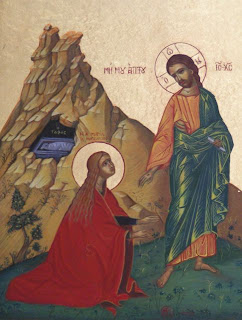
What is the male response? Proclamation. The Ark bears the Covenant, the Covenant is God's Word, the Word is Proclaimed. The Evangelion first comes to the men through the women, and the men proclaim it. Mary approaches Elizabeth, bearing Christ in her womb, and John himself, not much further along, leaps within the womb. I don't think this is an exhaustive notion - it's merely an analogical model, but...
Is this role of Mary indicative of a spiritual capacity, found in women par excellence, that we are not recognizing? Could this capacity be sacramental (it did indeed mediate grace, and Christ, in a manner of speaking, did institute their unique place in bringing him forth) ?
And what of the question of sex vs. gender? To what degree must someone identify as male to be considered male, or is it merely a question of biology? Can we still use a (JP2's?) notion of male-female complementarity? How can we shape our ministry to encompass those who would seek Christ yet have, in the words of Thomas, "some obstacle" which confounds our either/or model which doesn't take into account what current gender theory seems to suggest: that gender, sex, and sexual orientation, while related, are not the same things?
Whatever answers can be given for these questions, there are a few things that we must assert: Women are of equal dignity, and their unique proclivities as women must be elevated and valued to represent this. We must acknowledge in all areas of culture that they are people of dignity, not to be denigrated for their beauty to the male eye (and made to be objects of lust or adornments), not to be thought weaker for their role in motherhood (but rather, stronger), and not to be thought unable to accomplish something because of any accident of their soul (we must avoid falling into the archaic "fairer" / "lesser" sex mindset). We must also endeavor to respect, trust, and be obedient to the Magisterium in this regard as well, despite having the courage to challenge weak arguments and leaps of logic, so that what is true and what is just is what is affirmed not merely in content of Church teaching but in form and expression in letter and practice.
Wednesday, September 29, 2010
Feast of the Archangels

Art by Sarah May Butcher
Today was the feast of the Archangels! I was fortunate enough to be able to read at midday prayer, and fact that it was the feast day of my confirmation and patron saint (St. Gabriel) lifted my mood despite some otherwise undesirable circumstances.
Why do I love St. Gabriel so much? Part of it has to do with a fascination with angels I had when I converted, but also because it is Gabriel who comes to Mary and announces her to be the ark of the new covenant, which exalts her womanhood and motherhood. It is Gabriel who speaks the words of God so clearly, who helps Daniel to understand his dreams, announces the births of John the Baptist and Jesus, and even instructs the unborn in the womb. For Christians, Gabriel is the angel of the Incarnation, consolation, and mercy. He's just so cool!

As is my custom, here's a bit of prayer, with a few pieces of the litany that I particularly identify with or aspire to emphasized:
Litany of St. Gabriel
Lord, have mercy on us. Christ, have mercy on us. Lord, have mercy on us.
Christ, hear us. Christ, graciously hear us.
God the Father of Heaven, Have mercy on us.
God the Son, Redeemer of the world, Have mercy on us.
God the Holy Spirit, Have mercy on us.
Holy Trinity, One God, Have mercy on us.
Holy Mary , Queen of Angels, pray for us.
Saint Gabriel, glorious Archangel, pray for us.
St. Gabriel, strength of God, pray for us.
St. Gabriel, who stands before the throne of God, pray for us.
St. Gabriel, model of prayer, pray for us.
St. Gabriel, herald of the Incarnation, pray for us.
St. Gabriel, who revealed the glories of Mary, pray for us.
St. Gabriel, Prince of Heaven, pray for us.
St. Gabriel, ambassador of the Most High, pray for us.
St. Gabriel, guardian of the Immaculate Virgin, pray for us.
St. Gabriel, who foretold the greatness of Jesus, pray for us.
St. Gabriel, peace and light of souls, pray for us.
St. Gabriel, scourge of unbelievers, pray for us.
St. Gabriel, admirable teacher, pray for us.
St. Gabriel, strength of the just, pray for us.
St. Gabriel, protector of the faithful, pray for us.
St. Gabriel, first adorer of the Divine Word, pray for us.
St. Gabriel, defender of the Faith, pray for us.
St. Gabriel, zealous for the honor of Jesus Christ, pray for us.
St. Gabriel, whom the Scriptures praise as the Angel sent by God to Mary, the Virgin, pray for us.
Lamb of God, Who takest away the sins of the world, Spare us, O Lord.
Lamb of God, Who takest away the sins of the world, Graciously hear us, O Lord.
Lamb of God, Who takest away the sins of the world, Have mercy on us.
Christ, hear us. Christ, graciously hear us.
V. Pray for us, blessed Archangel Gabriel,
R. That we may be made worthy of the promises of Jesus Christ.
Let Us Pray: O blessed Archangel Gabriel, we beseech thee, intercede for us at the throne of Divine Mercy in our present necessities, that as thou didst announce to Mary the mystery of the Incarnation, so through thy prayers and patronage in Heaven we may obtain the benefits of the same, and sing the praise of God forever in the land of the living. Amen.
Saturday, September 25, 2010
Blankets, and my Grandpa, in Dreams.
A recurring theme in my dreams of late has been that of giving a cold person blankets. A few weeks ago, I dreamed that I was huddled in some blankets (the blankets usually on my bed) when a homeless person approached me and asked me for spare change. The environment was apparently such that I appeared to be wealthier than he, in any case. I told him that while I had no change, I had spare blankets he could keep warm in... and he seemed pleased with this, and took them graciously.
Just now, I awoke from a dream in which I recognized my Grandpa Torbeck was with me. He was reclining on a mattress, and we spoke a bit. The light in the room was the same brightness and colour it had always been in his living room - shaded lamplight, hued a slight orange from the lampshades and wood-paneled walls. I told him that he has many grandchildren to be proud of (ironically only one more than when he passed away, so it's not as if he didn't know this - and indeed, he responded, "I know."), and that I was writing a book (I'm not currently, though I hope to). I mused quietly that I had so much to ask him, and then I noticed he was shivering.
"Grandpa, are you cold?" I asked. "Actually, I'm freezing, buddy," he answered. I covered him with two blankets (again, from among those I generally have on my bed, the warmest two), and he pulled another (one that I had grown up sleeping with but no longer have) over him as well. He fell asleep, looking a frailer man than I had realized him to be at first.
I wonder if there's any significance to the blankets in my dreams... Anyway, this dream meandered through all kinds of scenarios, and this was but the end, but what a joy it was to talk to Grandpa again, even if only in a dream.
Sunday, September 19, 2010
Virtue as Refuge: A Reflection on a Dharma Talk

The Mid-America Buddhist Association (MABA) sprawls over sixty acres of secluded hillside, set back from the main road amidst trees and a beautiful pond full of waterlilies. A handful of Buddhist monastics work the grounds and keep the gorgeous area up for their weekly communal gatherings - gatherings that seemto me more like a family getting together than a worship service. Perhaps by virtue of the commitment required - being so secluded, the journey to MABA is quite a drive - or by the virtue of the small number of Buddhists in Missouri, the congregants arrive, chant, meditate, eat, and visit together over the course of three hours or more each Sunday. It's humbling, compared to many experiences I've had in parishes more familiar, where the congregation is too busy worrying about other business to enjoy the koinonia that could be theirs. A minute too long, and the congregation is unhappy and grumbling. I've even heard of one congregation that neglects the Gloria in the Mass because they think it takes too much time.
None of that is really the intent of this entry, however. The intent is to comment a bit on a talk that Venerable Kaizhao gave just after meditation, on the application of Dharma (essentially the Buddhist notion of "Gospel") in our daily lives. I was particularly struck, being heavily formed by the Thomistic theology of the Dominicans I study with, by the notion of Karma, specifically as refuge. Karma is essentially what Thomas speaks of when he talks of the relationship between virtue, vice, and habitus.
Karma can be roughly spoken of as the energy that forms the habitus from virtuous (or vicious) action. The action cultivates an energy that then returns to us - in the case of virtue, we cultivate peace and move toward Happiness. In the case of vice (also referred to as unwholesome action), we cultivate unhappiness. Venerable Kaizhao spoke of Karma as a refuge. This idea seemed intriguing and played at my imagination; I wondered,
what can I take from this notion?"
what can I take from this notion?"
In Thomistic Anthropology, virtues reside in powers of the soul, and shape the power in which they reside. For example, Prudence resides in the Intellect, and prudent actions will shape the intellect so that it makes better decisions, and becomes more naturally prudent. A more prudent Intellect will more readily and easily guide the Will, which will help guide the Soul and the whole being of the person toward Happiness. To the contrary, vicious actions, imprudent, frivolous, hateful, and other types of actions, cultivate the opposite effect.
Virtue, then, is our refuge in that it provides our souls shelter from unhappiness. Unwholesome acts invite bad karma, inviting chaos and destruction into our shelter, casting our house (our souls) into disarray. We see this manifest in the disordered concupiscences of the Will and Sensitive Appetite, in the corruption of our imagination, and in the lack of prudence in our Intellect.
Venerable Kaizhou emphasized that these results are both public and private, and inescapable. I would add that these results are fostered not only large obvious acts of sin or virtue, but by the small things, the venial things as well. In a Catholic context, this is why the sacrament of Confession is so important, even for such things as venial sins - it cultivates a virtuous habitus by acknowledging and absolving even the peccadillos, so that all the small harms we may do to ourself and others are not stumbling blocks and obstacles in our den. Confession "cleans our house," so to speak, setting our soul aright so that our actions might be free and excellent, unhindered by the burden of sin, and ordered to their proper end: our Happiness, found only in God the Father, the Son, and the Holy Spirit.
So, flee from sin, and cultivate virtue: pray, fast, give alms, partake in the sacramental life of the Church in all its fullness, both celebration and penance. This is the path to Happiness, our hope and our salvation.
[+]
~jacob w torbeck
Subscribe to:
Posts (Atom)